

The SME Digitalisation Report: How Small Businesses Are Approaching Digital Transformation in 2026

Digitalisation is transforming how small and medium-sized enterprises (SMEs) operate. However, for many small businesses, the process can feel overwhelming.
While larger enterprises may have the resources to adopt new technologies quickly, SMEs often face unique challenges that can slow their digital adoption.
To understand exactly what barriers they’re facing, we asked 700 UK-based business owners and managers about their digital priorities, the hurdles they face, and the tools they’re relying on to stay ahead in 2026 and beyond. Our findings not only offer a snapshot of where SMEs stand today but also provide practical advice for overcoming obstacles and accelerating progress.
Methodology
This survey was conducted in October 2025 through the PollFish survey platform, targeting 700 SME owners and managers in the UK. The survey included 15 multiple-choice questions around how their business is approaching, or planning to approach, digitalisation.
The data explores their digitalisation priorities, strategies, and the role ISO Management Software, such as Be Certified plays in their efforts.
The data was broken down by the following industries: education, healthcare, manufacturing, construction, retail, financial services, hospitality and tourism, and IT.
Report summary
-
- Is digitalisation a priority for SMEs in 2026?
- What business area is the highest priority for future digitalisation?
- What benefits are SMEs seeing from digitalisation?
- What challenges are SMEs seeing from digitalisation?
- What processes have SMEs already digitalised?
- What digital processes do SMEs plan to implement in the next year?
- Why are SMEs choosing to digitalise?
- How are SMEs choosing to digitalise?
- How are SMEs approaching digitalisation training?
- How do SMEs feel about digital consultancy tools?
- What government support do SMEs want to see to aid digitalisation?
- Delving into data and AI
Is digitalisation a priority for SMEs in 2026?
- 55% say digitalisation is a strong priority for growth next year
- 36% say it’s a moderate priority
- Just 6% place it as a low priority
- Only 2% say it’s not a priority at all
The sectors which are prioritising digitalisation the most:
- IT – 81%
- Financial Services – 71%
- Professional Services – 49%
- Retail – 48%
- Construction -47%
The sectors which are prioritising digitalisation the least:
- Education – 11%
- Healthcare – 10%
- Manufacturing – 10%
- Construction – 8%
- Hospitality and Tourism – 3%
Small businesses aren’t waiting for digitalisation to happen to them; they’re actively making it part of their growth plans. With 91% of SMEs placing digitalisation somewhere on their priority list for 2026, the appetite to modernise is strong.
Unsurprisingly, IT leads the charge, with a huge 81% saying digitalisation is a strong priority. Close behind is financial services, at 71% — a sector where data-driven decision-making and regulatory changes make digital tools essential.
What’s particularly interesting is that in sectors traditionally viewed as hands-on or heavily regulated, digitalisation is no longer a ‘nice to have’. Construction, hospitality, manufacturing, and healthcare — sectors often associated with manual processes — all saw close to half of respondents ranking digitalisation as a strong priority.
Even the education sector, which scored lowest overall, still saw two in five marking digitalisation as a high priority for the year ahead.
This shows us that, while progress and starting points differ, SMEs across a broad range of sectors are committed to digital transformation. They’re already on board, but now the task is making sure they have the right tools, guidance, and confidence to keep that momentum going.
What business area is the highest priority for future digitalisation?
- 28% of SMEs say data and artificial intelligence (AI) will be their top area of focus
- Compliance and certification appear at the bottom of the list, with only 3% of businesses viewing it as their highest priority
- 19% prioritise improvements in sales and marketing
- 12% point to security as a key future investment area
- 12% will prioritise operations and supply chain
Data and AI continue to shine at the top of the priority list (28%), sales and marketing (19%) takes the second spot, and security and operational improvements (12%) follow in joint third.
Interestingly, compliance and certification, which are key to regulatory adherence and data security, are not receiving the same level of attention: only 3% of SMEs prioritise compliance and certification as a top area for future digitalisation.
However, 30% of businesses do plan to digitalise their compliance and certification processes in the future.
Digitalising these processes, such as through ISO 27001 certification, can not only improve operational efficiency but also mitigate the risks of fines and reputational damage due to non-compliance.
Here are the priority business areas by industry:
- Construction: Data & AI — 26%
- Education: Workforce & collaboration — 30%
- Financial Services: Accountancy & finance — 36%
- Healthcare: Data & AI — 33%
- Hospitality: Sales & marketing — 31%
- IT: Data & AI — 53%
- Manufacturing: Operations & supply chain — 26%
- Retail: Sales & marketing — 37%
These industry breakdowns reflect the unique priorities of each sector. For instance, in construction, data and AI (26%) are driving enhanced project efficiency, while healthcare (33%) could be using AI to improve patient care. IT leads with data and AI (53%), focusing on operational improvements and innovation.
Given the recent struggles in the hospitality sector, digital marketing tools are seen as vital for customer retention and acquisition. Reports predict 378 pub closures in the UK in 2025 due to financial pressures, underscoring the need for effective digital strategies in a competitive and high-risk environment.
What benefits are SMEs seeing from digitalisation?
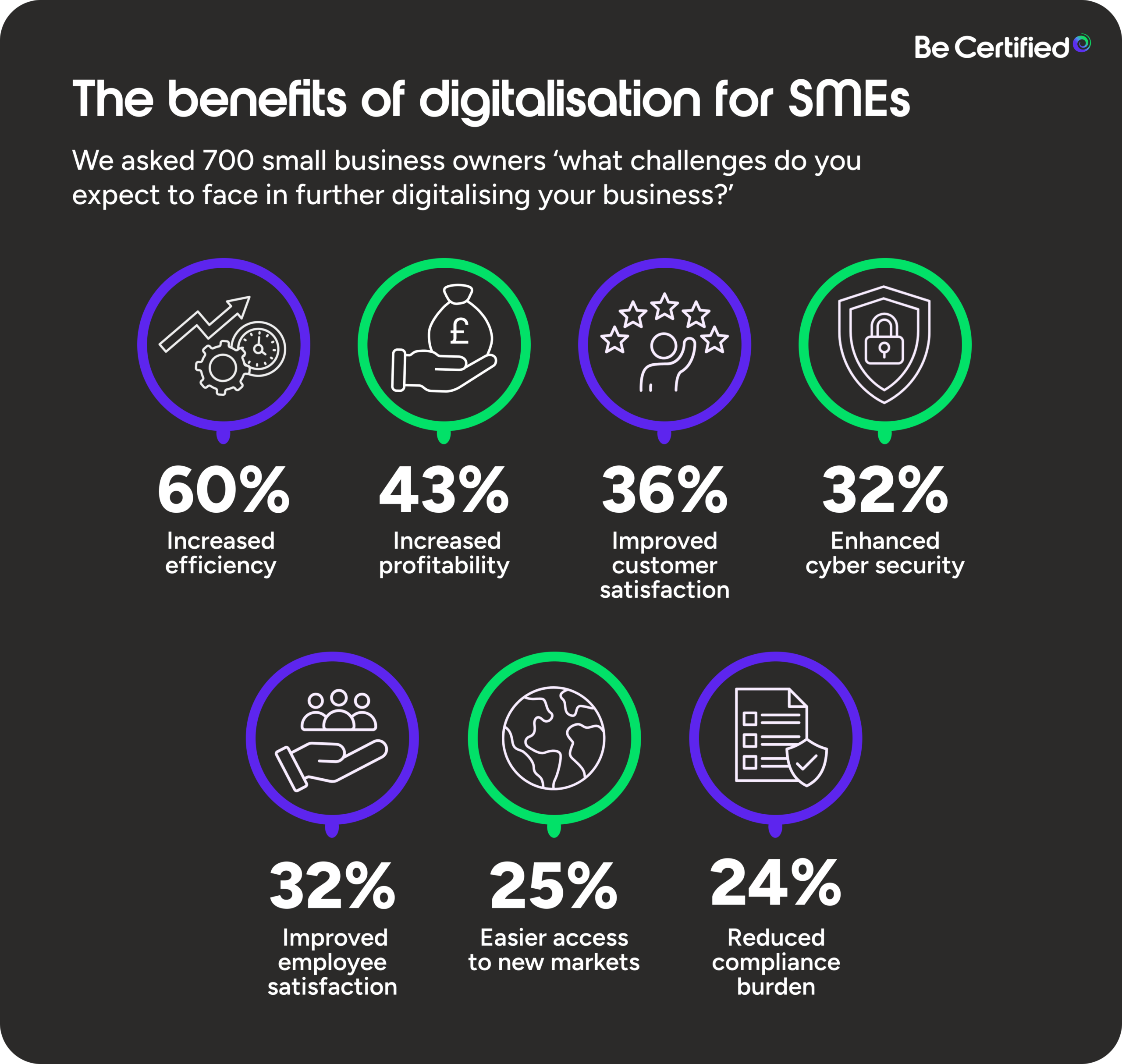
Digitalisation is already delivering tangible benefits for SMEs: 60% reported efficiency gains. This not only frees up time but also allows businesses to focus on what truly matters, whether that’s delivering a better product, nurturing customer relationships, pursuing new revenue streams, or investing in internal development, such as training for certifications or achieving industry accreditation.
43% of SMEs also reported an increase in profitability thanks to their digital transformation. This suggests that the long-term financial benefits outweigh the upfront cost of investing in technology.
Customer satisfaction also emerges as a key benefit, with 36% of businesses indicating that they’re able to meet customer expectations more effectively.
A crucial aspect of digitalisation is its impact on compliance. Almost a quarter (24%) of SMEs said digitalisation has helped to reduce their compliance burden, which can be a significant relief given how complex and time-consuming traditional, non-digital compliance processes can be.
In fact, the sector that most benefits from digitalisation when it comes to ensuring compliance with regulations is healthcare. One in seven healthcare businesses reported this as a key benefit of digital tools.
What challenges are SMEs seeing from digitalisation?
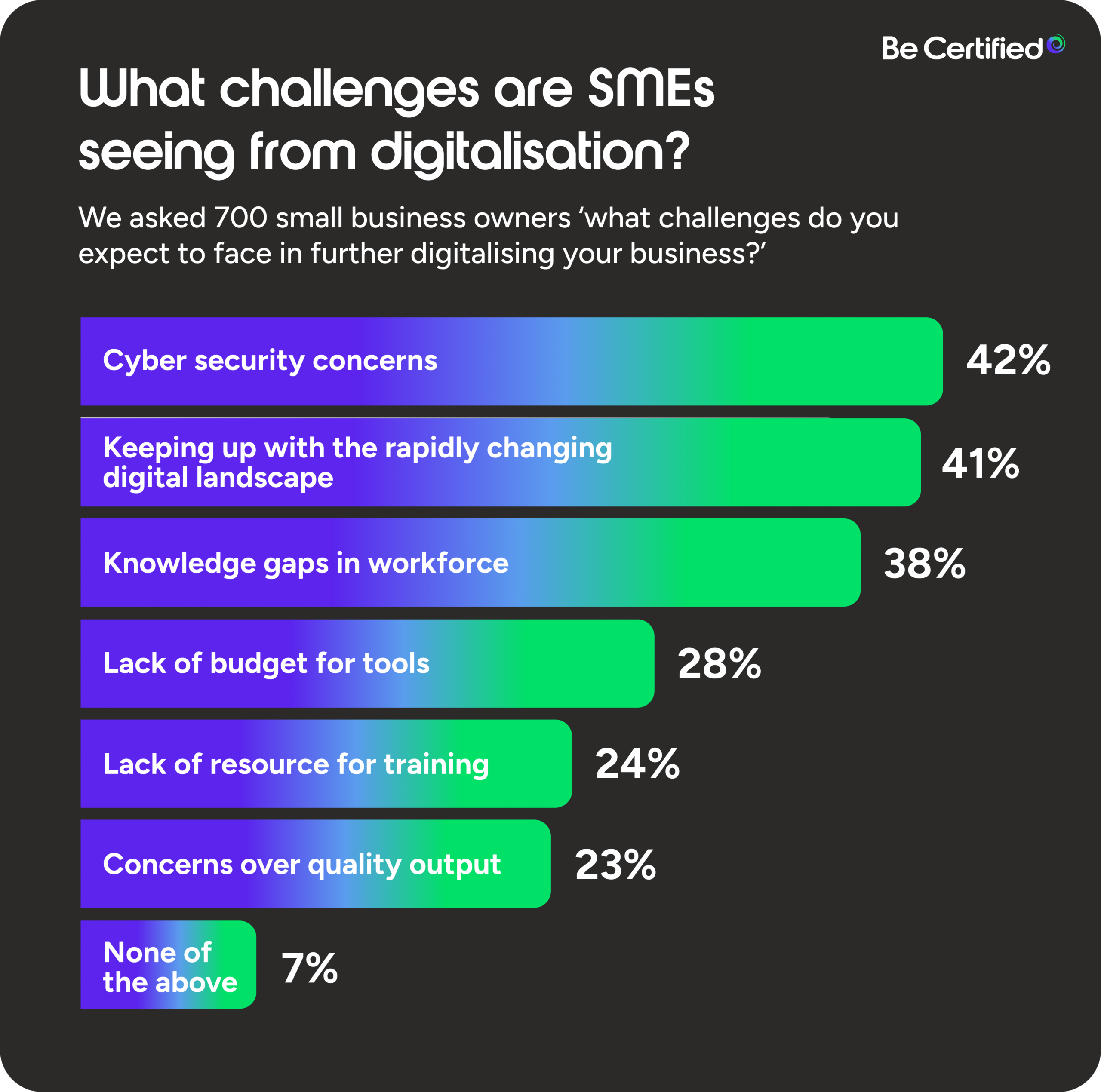
The biggest challenges by industry:
- Construction: 48% said cyber security
- Healthcare: 47% said cyber security
- Education: 48% said knowledge/skills gaps
- IT: 55% said cyber security
The data shows that while digitalisation is firmly on the agenda for many UK SMEs, the journey is far from smooth.
Over four in ten (42%) businesses view cyber security as the biggest roadblock to moving forward, which isn’t surprising, considering how often cyber attacks are making headlines. A recent report found that 27% of UK businesses were hit by a cyber attack between 2024-25: up 16% from the previous year. For SMEs in sectors like construction (48%) and healthcare (47%), this concern is even more pressing, with almost half citing it as their top challenge.
Agnes Sopel, Lead Auditor and ISO Consultant at Be Certified, comments: “Cyber security remains the largest barrier for SMEs in digitalising their operations. As cyber-attacks grow in frequency and sophistication, businesses must ensure they adopt the right security tools to protect their data and processes. For SMEs, it’s essential to implement multi-layered security measures in addition to employee training. A cybersecurity framework like ISO 27001 can also help SMEs formalise their security strategy and ensure that their data and systems are protected against emerging threats.”
But security isn’t the only hurdle to digital transformation. Skills and training gaps are also holding many businesses back. Over a third (38%) of SMEs report that their workforce isn’t equipped with the digital skills needed to fully embrace new technologies. Nearly a quarter (24%) point to a lack of training as a key obstacle. In industries such as education, this challenge is even more pronounced, with nearly half (48%) citing a lack of knowledge in the workforce when using digital tools.
This variation by industry highlights that there’s no one‑size‑fits‑all solution, and digitalisation barriers differ depending on sector, size, and maturity. What’s clear, though, is that while the desire to digitalise is there, the path to doing so isn’t always straightforward.
Digitalisation isn’t just about installing new software or automating tasks. For SMEs, it’s about building secure foundations, equipping teams with the right skills, and allocating the necessary resources to push forward confidently.
What processes have SMEs already digitalised?
- 63% have digitalised accountancy and finance processes
- 55% have digitalised security tools and systems
- 52% use digital workforce and collaboration tools
- 51% have digitalised operations and supply chain workflows
- 51% have adopted digital sales and marketing tools
- 48% are using data and AI in some form
- Only 34% have digitalised compliance and certification processes
Our survey findings revealed that finance tools (63%), security software (55%), workforce platforms (52%), and sales systems (51%) have already made their way into the core operations of many small businesses.
But there’s one clear area that’s lagging: compliance and certification. Despite being critical for building trust and maintaining standards, just one in three (34%) SMEs have digitalised these processes so far.
Agnes Sopel adds: “It’s encouraging to see that some SMEs have embraced digital tools in their finance and operations. However, compliance and certification processes are often still handled manually, which can lead to delays and inefficiencies. We believe that bringing these areas into the digital fold will be a game-changer for SMEs. By adopting digital platforms, businesses can automate and streamline their compliance and certification processes, drastically reducing the time spent on paperwork and audit preparation.”
Research from the British Standards Institution (BSI) reports that 35% of organisations experience productivity improvements after implementing standards, with 20% adopting them specifically to boost productivity. This shows how standards help businesses streamline their operations, but many are still taking traditional routes to achieve their goals, even if these are more time-consuming and labour-intensive.
Digitalisation doesn’t stop at finance and workflows. By modernising compliance and certification processes, businesses can work faster, stay audit-ready, and unlock new opportunities — without the admin weighing them down.
What digital processes do SMEs plan to implement in the next year?
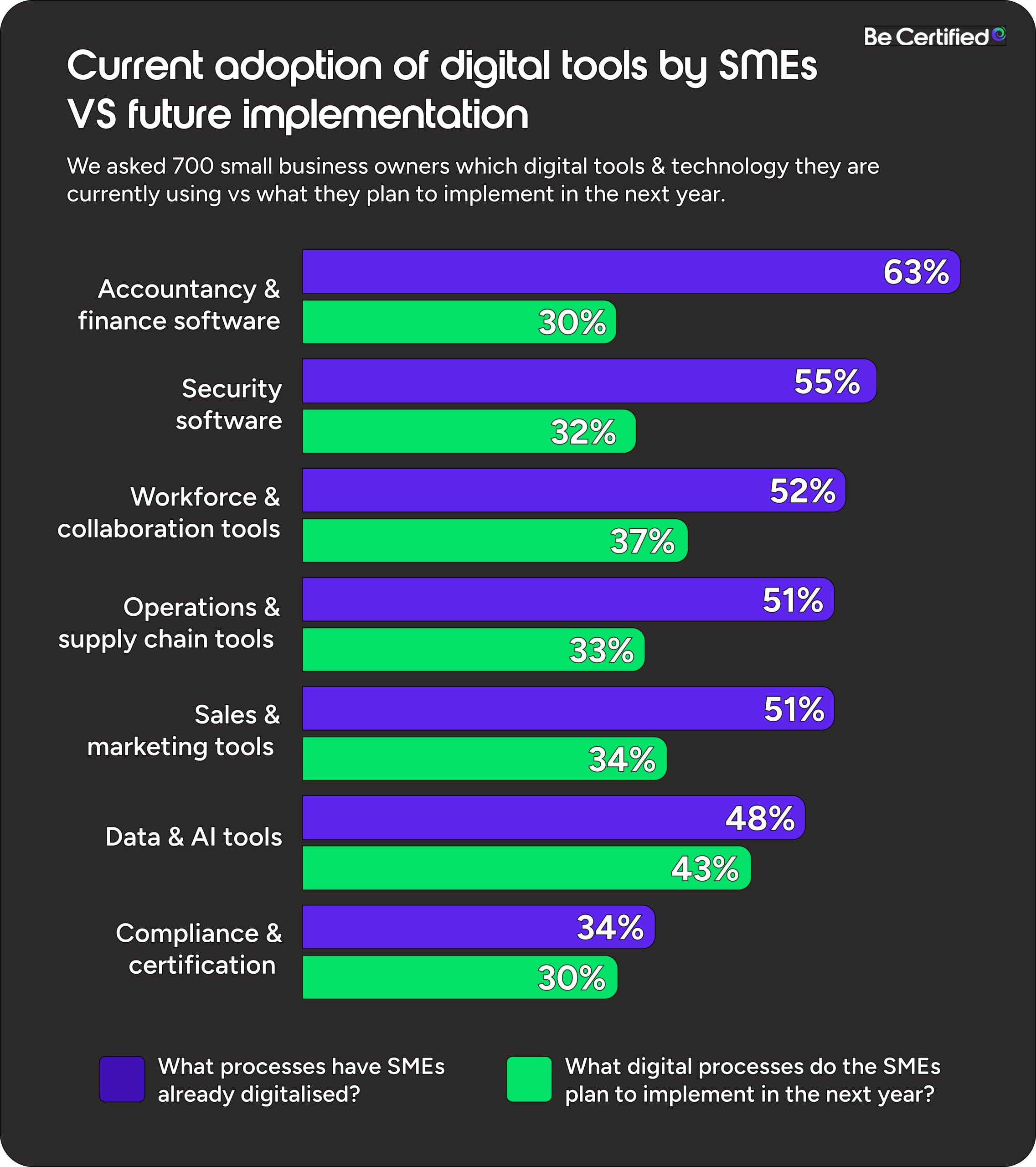
The majority of SMEs are turning their attention to data and AI (43%) in the next year, technologies that help them better understand their operations. Next are workplace and collaboration tools (37%), followed by sales and marketing processes (34%).
But once again, compliance and certification finds itself at the bottom of the list. Only three in ten (30%) SMEs plan to digitalise this area in the next year, even though ISO certification plays a significant role in unlocking credibility, contracts, and operational consistency.
The tech-forward IT industry shows what progress can look like, with over 40% planning to modernise their compliance workflows.
“While SMEs are putting data and AI at the top of their to-do list for the upcoming year, they must also think about how these tools are implemented securely. AI adoption presents both opportunities and risks, especially in terms of data security. Securing data used in AI systems, implementing GDPR-compliant platforms, and ensuring employee training on AI security risks are critical for SMEs to ensure safe innovation,” says Agnes Sopel.
Why are SMEs choosing to digitalise?
- 24% are focused on increasing overall productivity and efficiency to reduce operational costs
- 16% are looking to support business growth domestically
- 13% are aiming to improve customer experience
- 13% want to improve data security
- 12% seek to gain better insights into business performance
SMEs are choosing digitalisation as a way to tackle a wide range of challenges, but increasing efficiency and cutting operational costs is clearly top of mind for most. With 24% citing it as their primary reason, businesses are seeking tools that enable them to perform faster and smarter.
It’s a clever move: the more efficient your operations, the more resources you can free up to focus on growing the business, which is the second biggest driver, with 16% of companies prioritising digital tools to scale and expand their reach.
However, the number of SMEs focusing on international expansion is relatively low, with only 8% choosing it as a priority. This is reflected in the broader challenges UK SMEs face in expanding abroad; a British Chambers of Commerce report found that 27% of micro-exporters (businesses with 10 or fewer employees) saw a decrease in overseas orders in Q3 2025, compared to a boost for larger exporters.
How are SMEs choosing to digitalise?
- 30% are using in-house tools to manage their digitalisation
- 27% are relying on third-party tools
- 21% are using a hybrid approach, combining both in-house and external tools
- 17% are working with external consultants for guidance
- 4% say they rely on new hires brought in specifically for digitalisation
30% of businesses rely on in-house tools, while third-party tools account for 27% of SMEs’ digitalisation strategies.
17% work with external consultants for guidance, and 4% hire specifically for the task; an unsurprising outcome given that these can be much costlier for businesses than using tools, whether in-house or third-party.
How are SMEs approaching digitalisation training?
- 29% of SMEs offer online training courses via a platform
- 21% run informal internal training sessions led by employees
- 21% provide formal external training through third parties
- 19% rely on peer learning among employees
- 7% have no training in place yet, but plan to implement
- 3% have no training plans and are not considering it
- Only 1% feel their employees are already digitally skilled and don’t need training
Online training platforms are the most popular method, with 29% of businesses using them to upskill employees. Informal internal training also plays a significant role, with 21% of businesses. For example, automation, cost savings, and faster data analysis.
However, certification, for example, for ISO standards, came out as one of the lowest priority areas for digital consultancy tools, with only 7% of SMEs choosing it as a key focus. This represents a missed opportunity, and the lack of uptake suggests that SMEs may not yet fully understand how digital consultancy tools can simplify certification and compliance workflows.
Traditional methods for managing ISO standards often rely on manual tracking, complex paperwork, and significant time spent preparing for audits and assessments. By digitalising how certification evidence, policies, and actions are managed and organised, SMEs can reduce overhead admin, stay on top of requirements throughout the year, and approach audits with more confidence. s running peer-led sessions to share knowledge.
While informal training is usually more cost-effective, it can lack the expertise of more traditional training methods. A report revealed that 77% of leaders of SMEs in the UK lack the skills to implement new technology into their businesses, which could raise concerns about their ability to lead digital upskilling through in-house methods.
How do SMEs feel about digital consultancy tools?
- 13% would consider using digital consultancy tools for finance & accounting
- 13% for sales & marketing
- 12% for IT & digitalisation
- 10% for risk management (e.g., health & safety)
- 9% for operations & supply chain
- 9% for product development
- 8% for business strategy & growth
- 7% for legal
- 7% for human resources (recruitment, etc.)
- 7% for certification (e.g. ISO standards)
We found that SMEs are increasingly looking to digital consultancy tools as a viable option for many of their business needs.
The finance and accounting (13%) and sales and marketing (13%) areas stand out as the most likely candidates, possibly due to the clear benefits digital tools provide in these areas.
What government support do SMEs want to see to aid digitalisation?
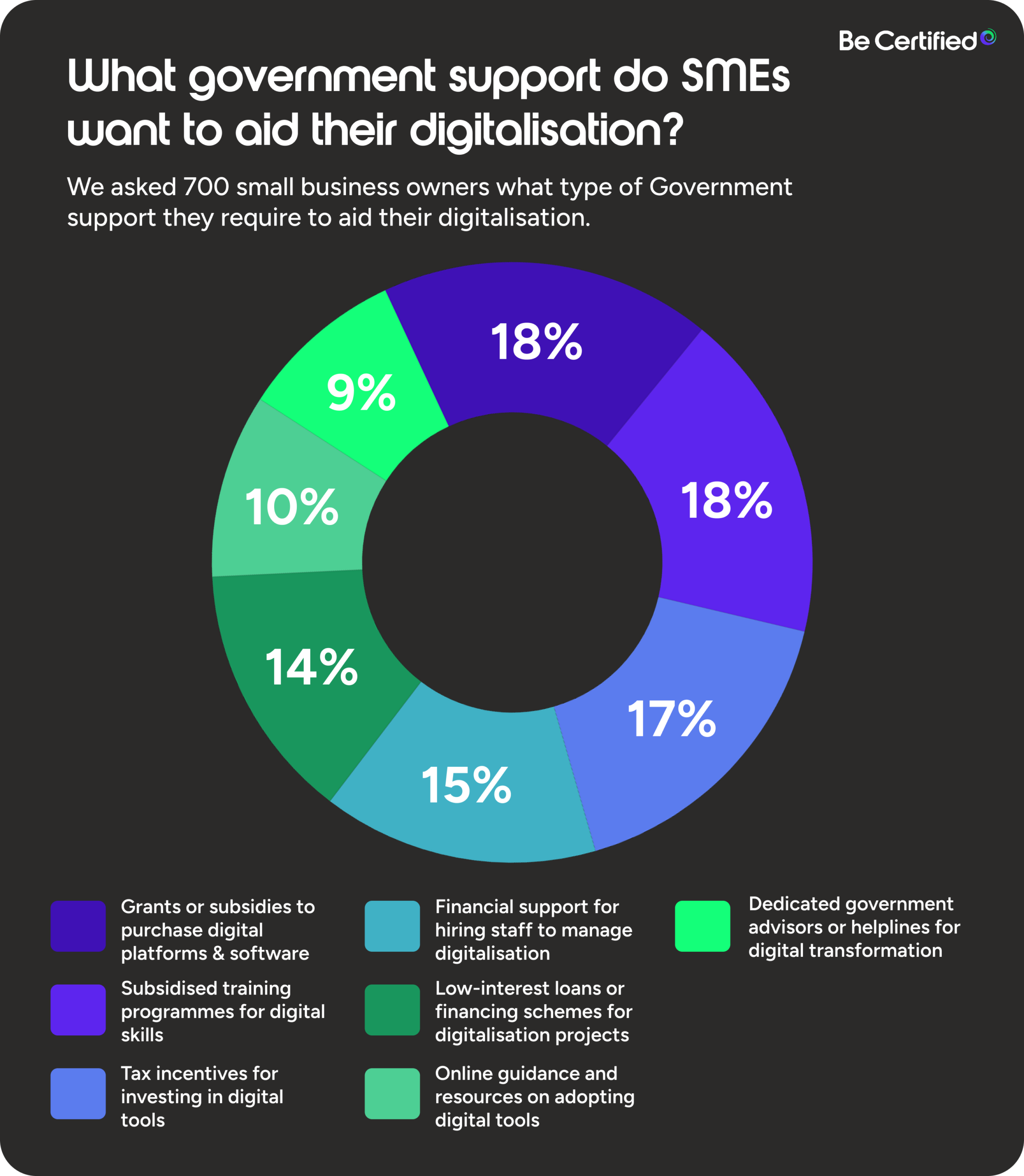
SMEs are clear about what would help them get past the digitalisation blockers: practical, cost-focused support. Grants, subsidies, and tax incentives top the list, with a combined 53% of businesses calling for help that would reduce the upfront cost of going digital.
There’s also a demand for stronger skills support. With 18% requesting subsidised training and 15% stating they need financial help to hire additional staff to manage digital change, SMEs recognise that people are a crucial part of the digitalisation puzzle.
And while funding is the priority, there’s still a clear appetite for guidance. SMEs don’t just want tools thrown at them; they want confidence that they’re choosing the right approach. Resources, helplines, and expert support are all seen as valuable stepping stones to help business leaders make informed decisions.
“Financial support and training are crucial to helping SMEs overcome the barriers to digital transformation. Digitalisation can provide fantastic cost savings for businesses in the long run – whether that’s through reduced headcount, improved efficiency, or savings in outsourcing and consultancy. But the upfront cost of transformation often deters them from embracing impactful change,” says Agnes Sopel.
“Additionally, training programmes tailored to specific sectors can equip businesses with the skills to handle new technologies. SMEs should actively seek out government initiatives that offer financial incentives for digital tools or cybersecurity measures, as well as educational opportunities to build internal expertise.”
Delving into data and AI
Following our study, we found that data and AI emerged as a clear top priority for many SMEs in their digitalisation journey, with 43% planning to digitalise these processes in the coming year.
Given its growing importance, we wanted to explore the current state of AI in SMEs and what it might mean for the future.
How is AI currently helping to support SMEs?
- 18% of SMEs are using AI to automate tasks
- 17% are using it for decision-making and strategic planning
- 16% are leveraging AI for customer engagement
- 16% say AI is enhancing their cybersecurity
18% of businesses are already using AI to automate tasks, reducing the burden of manual processes and freeing up valuable time for more strategic work.
AI-driven decision-making (17%) is also a notable trend, and customer engagement (16%) is benefiting from AI through the use of smarter tools, such as chatbots and enhanced customer service.
Cybersecurity (16%) is another key area where AI is playing a crucial role. With cyber-attacks becoming more sophisticated, AI tools that detect patterns, recognise threats in real-time, and respond to incidents faster are helping SMEs stay ahead of potential security breaches.
What are SMEs’ main concerns when it comes to AI?
- 19% are concerned about the accuracy of AI tools
- 18% worry about the impact on job replacement
- 15% are anxious about having a lack of knowledge to use AI
- 15% are concerned about the lack of regulation
- 12% feel that AI tools are too expensive
- 11% fear damaging relationships with customers
Accuracy is the biggest concern, with 19% of SMEs worried that AI tools might not always deliver the right results. The fear of job replacement (18%) is another significant issue.
At the end of the scale, a small group of respondents said they fear damaging customer relationships (11%), reflecting the importance of maintaining trust with clients.
What type of digital security measures are SMEs using?
- 20% have anti-virus and malware protection in place
- 18% use two-factor authentication
- 17% enforce strong password regulations15% use a VPN or firewall
- 14% conduct risk assessments
- 14% provide cybersecurity training
As cyber threats continue to evolve, SMEs are increasingly prioritising digital security measures to protect their businesses from attacks and data breaches.
Anti-virus and malware protection is the most widely used, with 20% of businesses relying on this as the first line of defence against malicious software.
Two-factor authentication (18%) is the second most common, reflecting SMEs’ awareness of the need for an additional layer of security beyond just strong passwords (17%). Risk assessments (14%) and cyber security training (14%) sit at the end of the list.
While these measures are a good start, cyber security training stands out as an area where more progress is needed. A government briefing estimated that 95% of cyber breaches stem from human error — from clicking a malicious link to misconfiguring a system. This highlights just how important it is for staff to be alert, equipped with the right tools and working in systems that help prevent mistakes in the first place.
Equally, businesses can benefit from adopting a more structured standard, like ISO 27001. This framework isn’t just about installing one or two tools; it’s about embedding information security into every layer of the business, from processes to people to technology. By aligning with ISO 27001, SMEs can move beyond basic patch-ups and build an information-security system that supports their entire digital journey.
In summary
SMEs are making significant progress in digitalising their operations, with data and AI at the forefront of their transformation. However, certification processes, such as ISO standards, remain an untapped opportunity. Only 7% of SMEs are focusing on digitalising their certification workflows, and this represents a significant opportunity to gain a competitive edge.
As businesses continue to adopt digital tools for every other area, compliance and certification should be next on the list for digital transformation — and it is for 30% of SMEs in 2026. Digitalising this process can save time, reduce errors, and ensure that businesses are audit-ready without the burden of manual paperwork. This allows SMEs to position themselves as more competitive and trusted within their industries.
“SMEs have proven that digitalisation saves time and boosts profits. The next step is the ‘last mile’: making compliance and certification just as digital as finance or security. That means simple workflows, clear evidence, and confidence that you’re meeting recognised standards,” says Agnes Sopel.
“At Be Certified, we’ve seen that embracing a digital approach to ISO certification is more than just streamlining processes; it’s about creating a sustainable competitive advantage.”
The opportunity to fully unlock the potential of digitalisation is right there, and SMEs are already laying the groundwork for success. By integrating compliance, certification, and cyber security alongside other digital initiatives, businesses are positioning themselves for an even brighter future.
Ready to streamline your certification process? Discover how Be Certified can help you achieve ISO Standards with ease.
Sign up to receive weekly Certification news
